- Dance Classes & Music Lessons
- 310.406.1730


At Home Confidence Kit: Guitar/ Bass/ Ukulele
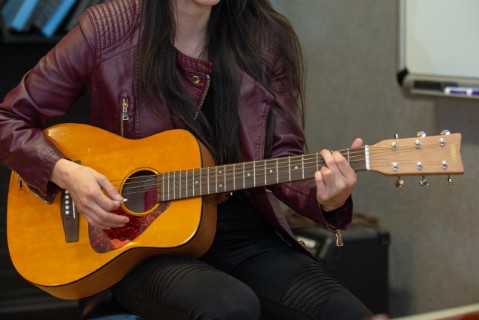
Before and during the early years of “real lessons,” the goal is rhythm, coordination, and loving the instrument – not shredding.
Older guitar students have enough strength, coordination, and focus to really build skills. Some are brand‑new; others have been playing for years. The goal is real songs, real habits, and real confidence.
What You Guitar Student is Working On
Younger Guitar Student:
Hold a child‑sized guitar or small bass comfortably
Strum or pluck open strings in time
Hear and copy simple rhythms (clap / tap / strum)
Notice high vs low, loud vs soft sounds
Follow simple 1–3 step directions in lessons
For older kids in this band (7–9): press strings clearly for single notes and starter chords/lines
Feel like “guitar/bass time” is fun, not stressful
Older Guitar Student:
Hold the instrument in a stable, relaxed way (right size guitar/bass)
Press strings clearly for single notes and basic chords (guitar) or lines (bass)
Coordinate both hands for strumming/picking and fretting
Count and play simple to intermediate rhythms in time
Read basic tab and/or notation, plus chord diagrams (guitar)
Play longer, more complex songs and riffs cleanly as they advance
Keep solid time with a metronome, drummer, or backing track
Practice more independently and plan 15–30 minute sessions
Play with others (bands, combos, ensembles) and handle mistakes on the fly
Younger Guitar Student:
Each time your child has one of these wins, add a sticker or checkmark. At the end of 30 days, look at how far they’ve come.
Held their instrument in class without dropping or fighting it
Strummed or plucked open strings to a steady beat (with help)
Clapped or tapped back a simple rhythm you did
Showed you a “guitar/bass sound” they learned in class
Played high vs low sounds on the instrument when you asked
Stayed engaged through most of a short practice/game at home
Talked about something fun from class
Asked to bring the instrument out at home
Tried again after a “sour” sound without getting upset
At the end of 30 days, point out 2–3 ways they’re more comfortable with the instrument than on day 1.
Older Guitar Student:
Each time one of these happens over the next 30 days, mark it. At the end, talk about habits and growth, not “talent.”
Practiced at least 15 minutes in a day
Practiced 3+ days in a week
Held the instrument with good posture (no full slouch, no “turtle neck”)
Played a simple rhythm in time with a metronome or track
Switched cleanly between two chords or two notes a few times
Kept going after a mistake instead of quitting
Played a short song or riff from beginning to end
Broke a hard section into smaller parts and drilled it
Showed you something they learned in lessons
Younger Guitar Student:
1. Rhythm Strum
You clap a simple pattern (clap‑clap‑pause‑clap).
They clap it back, then strum it on open strings.
Builds: beat and coordination.
2. High–Low Explorer
Ask: “Can you find the highest‑sounding string? The lowest?”
Let them strum and point: “That’s the high one; that’s the low one.”
Builds: ear and fretboard comfort.
3. Freeze Strum
Strum together while you count “1‑2‑3‑4.”
On “STOP,” both freeze hands.
Change the tempo to make it silly.
Builds: control and listening.
Older Guitar Student:
1. 2‑Chord (or 2‑Note) Loop
Pick 2 chords (or 2 bass notes) from their song.
Set a slow count: “1‑2‑3‑4.”
Have them switch back and forth for 1–2 minutes without stopping.
Count “how many clean changes” they get.
Builds: transitions and stamina.
2. Riff Replay
Ask: “Play your favorite riff or line from lessons.”
Have them play it 3 times in a row without stopping.
You just say, “Again?” and cheer at the end.
Builds: repetition and confidence on something that matters.
3. Beat Buddy
Put on a simple song.
Have them play just root notes or one easy pattern with the track.
Goal = stay with the beat, not fancy fills.
Builds: time and feel.
4. Play Me Your Best 30 Seconds
Once a week:
“Show me your favorite 30 seconds you can play right now.”
No critique. Just: “That sounded awesome – I love hearing you play.”
Builds: identity and pride.
Younger Guitar Student:
Older Guitar Student: